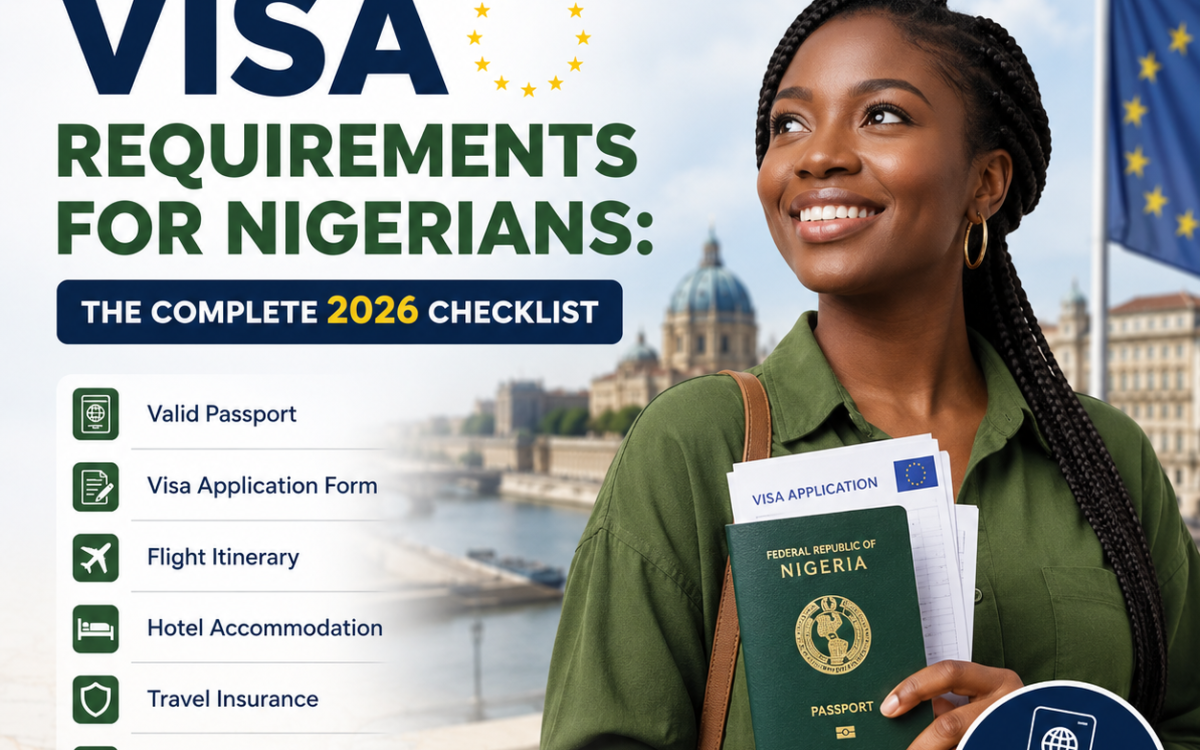

Schengen Visa Requirements for Nigerians: The Complete 2026 Checklist
Europe is one of the most searched travel destinations among Nigerians, and for good reason. The Schengen Zone covers 29 countries, meaning one visa can take you from the beaches…
Europe is one of the most searched travel destinations among Nigerians, and for good reason. The Schengen Zone covers 29 countries, meaning one visa can take you from the beaches of Portugal to the streets of Rome, the canals of Amsterdam, and the Alps of Switzerland without crossing a single border checkpoint.
But the Schengen visa also has one of the highest refusal rates among Nigerian applicants. Not because the process is impossible, but because many applicants submit incomplete files, underestimate the financial proof required, or apply through the wrong embassy entirely.
This guide gives you the complete, up-to-date checklist of Schengen visa requirements for Nigerian applicants in 2026: what documents you need, how they should be prepared, and what common mistakes to avoid before you submit.
If you would prefer to have a professional review your file before it goes to the embassy, take our Free Evaluation first, as it helps our team identify gaps in your profile before they become rejection reasons.
What Is the Schengen Visa?
The Schengen visa is a short-stay visa that allows holders to travel within the Schengen Area for up to 90 days within any 180-day period. It is issued by the member state that is your primary destination (or, if you are transiting through multiple countries for roughly equal periods, the country of first entry).
The 29 Schengen member states include Austria, Belgium, Croatia, Czech Republic, Denmark, Estonia, Finland, France, Germany, Greece, Hungary, Iceland, Italy, Latvia, Liechtenstein, Lithuania, Luxembourg, Malta, Netherlands, Norway, Poland, Portugal, Slovakia, Slovenia, Spain, Sweden, and Switzerland.
Common Mistake: Many Nigerians apply through the wrong embassy. For example, applying at the French embassy when their longest stay is in Italy. Always apply at the embassy of your primary destination country. If you spend equal time in multiple countries, apply at the embassy of your first port of entry. Applying at the wrong embassy is grounds for immediate rejection.
The Complete Schengen Visa Document Checklist for Nigerians (2026)
1. Completed Visa Application Form
Every Schengen country uses a standardised application form that must be fully completed in English or the official language of the embassy you are applying to. It must be signed and dated; unsigned forms are automatically invalid.
Some countries (France, Germany, Netherlands) have moved to online application portals and may require you to complete the form digitally before your appointment.
2. Valid International Passport
Your passport must:
- Be valid for at least three months beyond your intended date of departure from the Schengen Area
- Have at least two blank visa pages
- Have been issued within the last ten years
If your passport does not meet these conditions, renew it before applying. Submitting a borderline passport that expires shortly after your travel dates is a common reason for delays and refusals.
Tabula Rasa Tip: Include your old passports if you have them, especially if they contain previous Schengen or other international visas. A history of visa compliance in other countries significantly strengthens your application.
3. Passport Photographs
Two recent passport-sized photographs meeting the following specifications:
- Size: 35mm x 45mm
- White background
- Taken within the last six months
- Clear, frontal view of the face with no glasses, hats, or head coverings (except for religious reasons)
Photograph specifications vary slightly between embassies, so confirm the exact requirements on the embassy’s official website before printing.
4. Travel Itinerary
A detailed day-by-day travel plan showing:
- Your date of entry into the Schengen Area and date of departure
- Each country, city, and destination you plan to visit
- Accommodation details for every night of your stay (hotel bookings, Airbnb reservations, or a host’s address)
- Planned activities or purpose of visit
⚠️ Common Mistake: Submitting a vague itinerary like “visiting Europe for tourism” without specific dates, cities, or accommodation details signals poor planning to the visa officer and raises questions about the genuineness of your trip.
5. Flight Reservation (Not a Purchased Ticket)
Most embassies require proof of your intended travel dates in the form of a flight reservation, not a fully purchased ticket. This protects you from financial loss if your visa is refused.
The reservation should show:
- Your full name as it appears on your passport
- Outbound and return flight details
- Booking reference number
You can obtain a verifiable flight reservation from a travel agent or through flight reservation services. At Tabula Rasa, our Vacation Getaways service assists clients with obtaining the correct flight reservations and hotel bookings as part of a complete Schengen application package.
6. Proof of Accommodation
For every night of your stay in the Schengen Area, you need one of the following:
- Hotel or Airbnb booking confirmation showing your name, dates, and property address
- Invitation letter from a host who is a citizen or resident of a Schengen country, along with their ID and proof of their address
- Tour package confirmation if you are travelling on an organised tour
If you are staying with friends or family, their signed invitation letter alone is not sufficient; it should be accompanied by a copy of their residence permit or passport and proof of their address (utility bill or lease agreement).
7. Proof of Financial Means
This is one of the most critical parts of the Schengen application for Nigerian applicants, and the most common area where files fall short.
You must demonstrate that you have sufficient funds to cover your entire stay without working illegally in the Schengen Area. Most embassies use a daily minimum figure (commonly €50 to €100 per day, depending on the country) to assess whether your finances are adequate.
Acceptable financial documents include:
- Personal bank statements for the last three to six months, showing consistent balances and regular account activity
- Proof of employment and salary (employment letter, recent payslips)
- If you are sponsored, a sponsorship letter from the sponsor plus their bank statements and proof of their legal status
- Evidence of other assets such as property, investments, and fixed deposits
Common Mistake: A bank account that shows a large lump sum deposit shortly before the application, without a consistent transaction history to support it, is one of the biggest red flags in a Schengen file. Officers are specifically trained to identify “balance stuffing.” Consistent, organic account activity over several months is far more persuasive than an inflated balance with no supporting history.
8. Proof of Employment or Business Ownership
You need to demonstrate what you do in Nigeria and, by extension, why you have a reason to return. This ties directly to your strong ties to your home country.
For employees:
- Letter from your employer on official letterhead, stating your position, salary, length of employment, and approved leave dates
- Recent payslips (three to six months)
For business owners:
- CAC registration certificate
- Business bank statements
- Tax clearance certificate
For self-employed individuals:
- Evidence of active contracts, invoices, or professional memberships
- Personal and business bank statements
For students:
- Letter of enrolment from your institution
- Letter of permission from your university or school
- Evidence of parental or guardian sponsorship
Tabula Rasa Tip: The employment letter is often the most scrutinised document in a Schengen file after the bank statement. It must be recent (within 30 days of your application), on official letterhead, and signed by HR or a senior official. A generic or vaguely worded letter often leads to a request for additional documents or an outright refusal.
9. Travel Insurance
Schengen travel insurance is mandatory for all applicants. It must:
- Be valid for the entire duration of your stay and in all Schengen countries you plan to visit
- Cover medical expenses of at least €30,000
- Include coverage for emergency medical evacuation and repatriation of remains
Several international insurers offer Schengen-specific travel insurance policies accessible to Nigerians, including AXA, Allianz, and Europ Assistance. Confirm that your chosen policy explicitly states Schengen Area coverage.
Common Mistake: Some Nigerian applicants submit local travel insurance policies that do not specifically mention Schengen coverage or do not meet the €30,000 minimum. These are automatically rejected. Always confirm the policy is Schengen-compliant before purchasing.
10. Cover Letter
While not always listed as a mandatory requirement, a well-written cover letter can significantly strengthen your application. It serves as the narrative thread that connects all your documents.
A strong Schengen cover letter should:
- Introduce who you are and your purpose of travel
- State your intended travel dates and the countries you plan to visit
- Explain how you will fund your trip
- Confirm your intention to return to Nigeria, referencing your employment, business, or family ties
- List the documents enclosed in your application
A cover letter is particularly important if your financial situation is modest, if you have a previous refusal on record, or if your travel history is limited. Our General Services team assists clients who have received previous refusals or need help structuring a file that addresses specific weaknesses.
11. Proof of Accommodation in Nigeria (Optional but Recommended)
Some embassies, particularly the French and Spanish missions in Nigeria, have been known to request proof that you have a confirmed residence in Nigeria, such as a utility bill or property document in your name. Including this proactively demonstrates rootedness.
12. Additional Documents for Specific Categories
For retirees: Proof of pension or retirement income, recent bank statements.
For minors travelling alone: Notarised consent from both parents or legal guardians, birth certificate, copies of parents’ passports.
For minors travelling with one parent: Notarised consent from the absent parent, or court order granting sole custody.
For applicants with a previous refusal: A new, stronger application that directly addresses the reason for the previous refusal. Our General Services team can review your previous refusal letter and advise on what needs to change.
Where to Apply in Nigeria
There are two main Schengen visa application channels available to Nigerian applicants:
VFS Global handles visa applications for many Schengen countries in Nigeria, including Germany, France, Italy, Spain, Netherlands, and others. Applications are submitted at VFS centres in Lagos and Abuja. Visit vfsglobal.com to check which countries are currently processed through VFS in Nigeria.
Direct embassy appointments: Some countries, including Belgium and Austria, process applications directly through their embassies. Check the specific embassy’s website for current appointment availability and procedures.
Schengen Visa Fees (2026)
The standard Schengen visa fee is €90 (approximately ₦150,000–₦165,000 depending on the exchange rate) for adults. Children between 6 and 11 years pay €45. Children under 6 are exempt from the visa fee.
This fee is non-refundable, even if your application is refused.
Service fees charged by VFS Global are separate and vary by country.
How Long Does Processing Take?
Most Schengen embassies process applications within 10 to 15 working days, though this can extend to 30 days during peak travel seasons (June–August, December). Some embassies accept applications up to six months in advance.
Apply early. A minimum of six to eight weeks before your planned travel date is a safe buffer for Nigerian applicants, especially if your appointment slot availability is limited.
Final Thoughts
A Schengen visa refusal is rarely about bad luck. It is almost always about documentation. A file that tells a clear, consistent, well-evidenced story of who you are, why you are travelling, how you will fund the trip, and why you are coming back to Nigeria is the foundation of a successful application.
Gather every document on this checklist. Ensure your bank statement reflects genuine, consistent financial activity. Write a clear cover letter. Apply through the right embassy. And give yourself enough time to do it properly.
If you are unsure about any part of your file, or if you have been refused before and want to reapply with a stronger case, we are here to help.
Ready to plan your Europe trip the right way? Our Vacation Getaways service handles your Schengen visa application from start to finish: documents, itinerary, hotel and flight reservations, cover letter, and submission support. Start with our Free Evaluation to let our team assess your profile, or book a consultation directly. Call us on +234 702 507 5477 or visit tabrasat.com.

[…] core Schengen requirements don’t change by applicant type. Our complete 2026 checklist has the full list. What follows is what’s different for […]