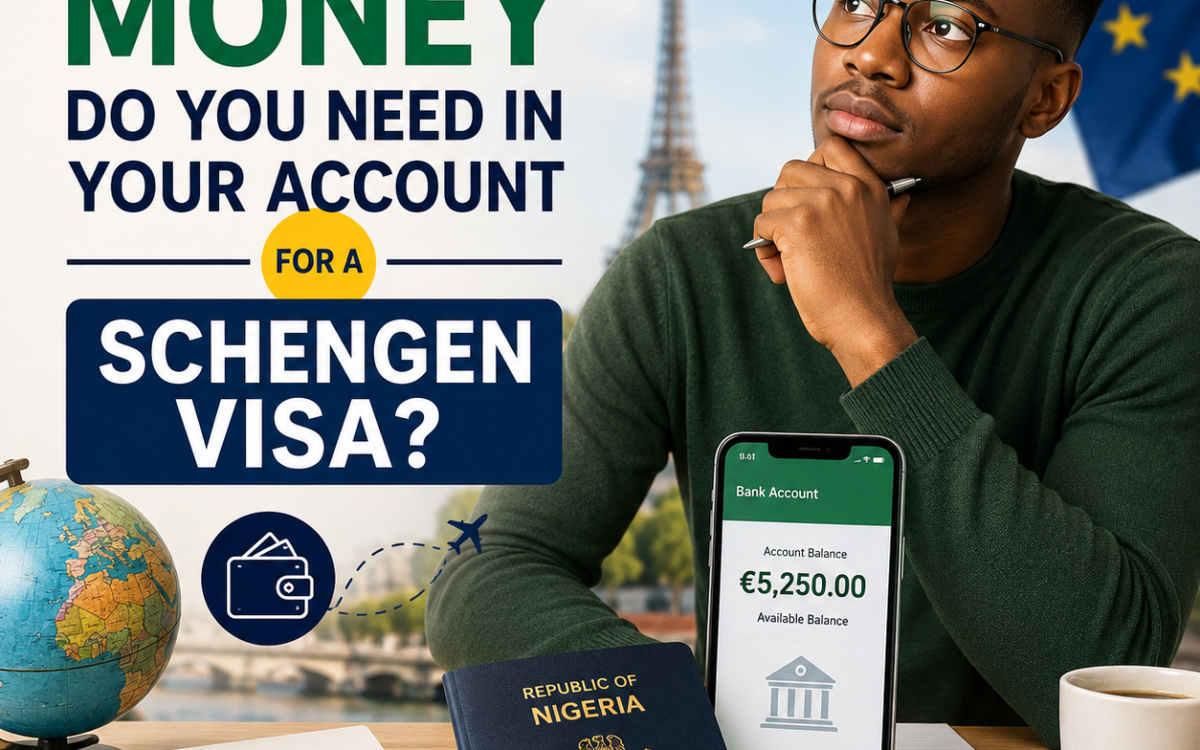

How Much Money Do You Need in Your Account for a Schengen Visa?
One of the most stressful questions in any Schengen visa application has nothing to do with your itinerary or your hotel booking. It’s this: how much money do you actually…
One of the most stressful questions in any Schengen visa application has nothing to do with your itinerary or your hotel booking. It’s this: how much money do you actually need in your bank account?
Get it wrong and your file can be rejected for “insufficient means of subsistence,” even when every other document is perfect. Show too little and you look unprepared. Show a suspiciously large amount that appeared overnight and you look like you borrowed it. This guide breaks down how much you need, how to calculate it for your own trip, and how to present it so the embassy trusts your file.
If you’d rather have an expert review your finances before you submit, our team offers tourist visa assistance and vacation planning that covers your proof of funds from start to finish.
What “proof of funds” really means
Embassies call it “means of subsistence.” In plain terms, it’s money to cover your day-to-day expenses while you’re in Europe: accommodation, food, local transport, and a little buffer for anything unexpected.
The reason the requirement exists is simple. Every Schengen country wants to be sure you can support yourself during your stay and that you won’t become a financial burden or overstay to look for work. It’s one of the core entry conditions under the Schengen Borders Code, alongside a valid passport, travel medical insurance, and a clear purpose of travel.
Two things trip people up here. First, the daily amount is meant to cover what you spend on the trip, so paying for your flight or hotel in advance doesn’t automatically lower the balance you need to show. Second, the process is very case by case. Two travelers with identical trips can be assessed differently based on their history, nationality, and how their finances look on paper.
The short answer
There’s no single Schengen-wide number, because each member state sets its own daily reference amount. As a planning figure, most applicants should be ready to show roughly €100 to €120 per day of their stay. Some countries ask for far less, and a few ask for more, but that range keeps you safe for the most popular destinations.
The official amounts are published by the European Commission in Annex 25 of the Visa Code Practical Handbook, and consulates update them from time to time. You can read the Commission’s own overview of the requirements on its official Schengen visa page.
Reference amounts by country
The table below shows commonly cited daily reference amounts for short-stay visas. Treat these as a guide, not gospel. Consulates revise them periodically, and the final decision always rests with the visa officer.
| Country | Typical daily reference | Notes |
| France | About €120, or about €65 if accommodation is prepaid | Verify on the France-Visas portal |
| Germany | Around €45 historically, though many consulates expect €100 or more | Set per consulate |
| Spain | About €113 to €122, with a minimum of roughly €1,000 for the whole trip | Recalculated yearly from the minimum wage |
| Italy | About €120 for shorter stays | Uses a sliding scale, higher per day for short trips |
| Greece | About €50 | One of the lower requirements |
| Netherlands | About €55 | |
| Belgium | About €95, or about €45 if staying with a host | |
| Portugal | About €75 on entry plus about €40 per day | |
| Switzerland | No fixed figure, about €100 recommended | Officer discretion |
| Latvia | About €14 | Among the lowest in the zone |
| Poland | About €18 | |
| Bulgaria | About €50 |
A low minimum doesn’t mean an easy approval. Countries with small daily figures still look closely at your overall financial profile, your travel history, and the quality of your documents. Always confirm the current figure for your destination directly with its consulate before you apply, since these numbers do change.
How to calculate what you need
Use this formula:
Required amount = (daily rate × number of days) + a safety buffer
Say you’re planning a 10-day trip to France. At about €65 per day with a prepaid hotel, the bare minimum works out to €650. But nobody serious stops at the minimum. To present a strong file, you’d aim to show closer to €1,000 to €1,300 in your account.
If your trip covers more than one Schengen country, plan around the destination with the highest requirement, not the lowest. That way your balance satisfies every stop on the route.
The unwritten rule: always show more than the minimum
The official figures are floors, not targets. In practice, experienced applicants show 1.5 to 2 times the minimum. A visa officer isn’t just checking whether you technically hit a number — they’re forming a judgment about whether you’re financially stable and likely to return home.
Showing a comfortable cushion signals exactly that. Showing the bare minimum and nothing else invites doubt, and doubt is what fills rejection letters.
What counts as proof
The money in your account only helps if you prove it correctly. The documents that carry the most weight are:
- Bank statements for the last three to six months, stamped and signed by your bank. Several consulates, including Spain, France, Italy, Portugal, and Greece, now ask for six months rather than three.
- Salary slips for your last three months, on company letterhead.
- An employment letter confirming your position, salary, and approved leave.
- Tax returns for the last two to three years, which matter especially for the self-employed and freelancers.
- A sponsorship letter with the sponsor’s own financial documents, if someone else is funding your trip.
Consistency matters more than a single high number. A steady balance with regular income tells a far better story than a large, unexplained lump sum.
Mistakes that get applications rejected
These are the errors that quietly sink otherwise solid files:
- A sudden large deposit right before applying. This is the biggest red flag of all. It looks like borrowed or “parked” money, and officers spot it easily.
- A balance that swings wildly across the statement period. Aim for stability in the months before you apply.
- Using the wrong country’s number. Applying for Italy while showing the Greece minimum is a classic and costly mistake.
- Crypto, property, or land documents presented as liquid funds. These are generally not accepted as bank-balance proof.
- Statements that are just printouts. Most consulates want them stamped and signed by the bank.
What if you don’t have enough?
You still have options. The most common is sponsorship, where a parent, spouse, close relative, or employer covers your trip. This usually requires a formal sponsorship letter plus the sponsor’s own bank statements and, in some countries, a notarised declaration. Germany, for example, accepts a formal sponsorship declaration known as a Verpflichtungserklärung.
Prepaid accommodation and confirmed bookings can also strengthen a modest balance, and a clear cover letter that explains who is paying for what goes a long way. If your finances are complicated, this is exactly the kind of situation where a second set of expert eyes helps. You can book a consultation or take our free evaluation to see where you stand before you spend a cent on fees.
A quick note on 2026 changes
Europe’s entry rules are shifting. The Entry/Exit System is already in operation, and the ETIAS travel authorisation is set to launch later in 2026. ETIAS applies to visa-exempt travellers and doesn’t require proof of funds the way a Schengen visa does, though you may still be asked to show funds at the border. You can follow the official updates on the EU’s ETIAS information site. If you’re a Schengen visa applicant, everything in this guide still applies to you.
Final thoughts
The money question comes down to telling a believable, consistent financial story: steady income, a stable balance, and enough of a cushion to show you can comfortably fund your trip and will return home afterwards.
Get the numbers right, present them cleanly, and avoid the last-minute deposit trap. That alone removes one of the most common reasons for rejection.
Not sure your finances are ready for scrutiny? That’s what we’re here for. Explore our full range of services, browse more guides on the Tabula Rasa blog, or contact us and let our experts structure your application for the best possible chance of approval.

Great content! Keep up the good work!