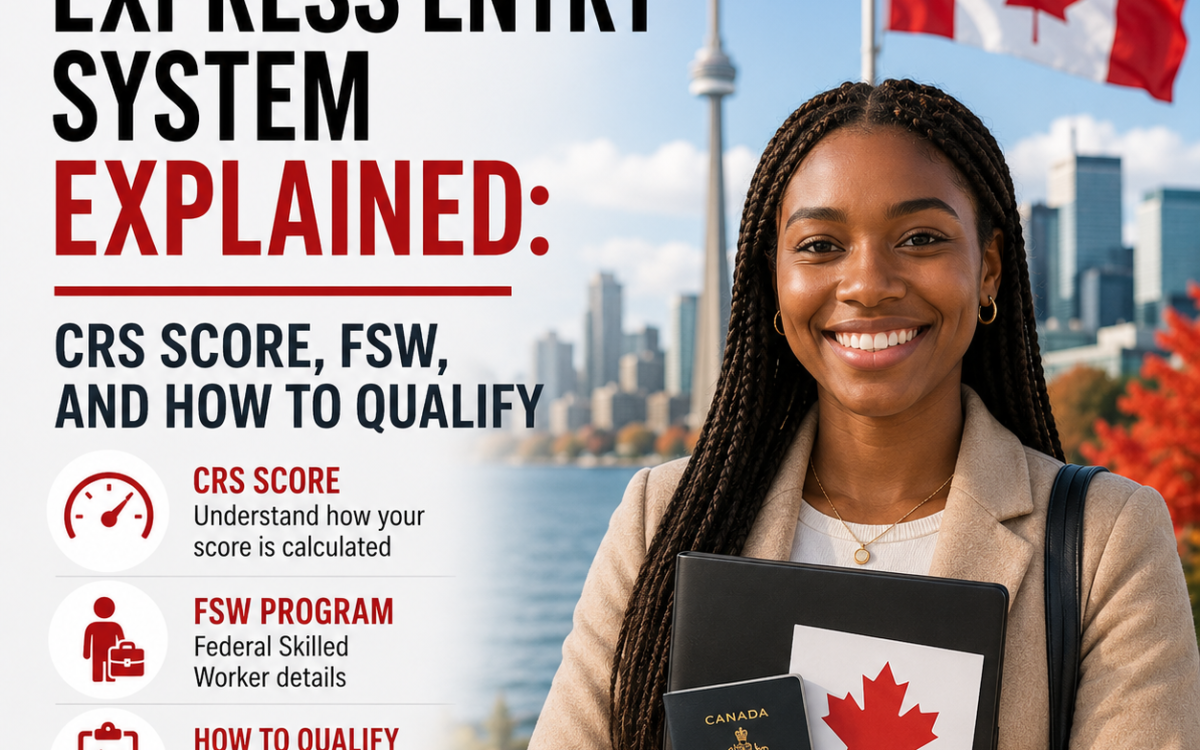

Canada Express Entry Explained: CRS Score & Eligibility for Nigerians (2026)
If you have spent any time researching how to immigrate to Canada, you have almost certainly come across the term “Express Entry.” It comes up in every forum, every YouTube…
If you have spent any time researching how to immigrate to Canada, you have almost certainly come across the term “Express Entry.” It comes up in every forum, every YouTube video, and every conversation about Canadian PR and for good reason. Express Entry is the primary system Canada uses to select skilled workers for permanent residency, and it has helped hundreds of thousands of people relocate successfully.
But the system is also widely misunderstood. Many applicants create a profile without understanding how they are actually scored, what affects their ranking, or why some candidates with seemingly weaker profiles get invited before others with stronger qualifications.
This guide breaks down exactly how Express Entry works, how the Comprehensive Ranking System (CRS) score is calculated, what the Federal Skilled Worker (FSW) program requires, and what Nigerian applicants can do to improve their chances of receiving an Invitation to Apply (ITA).
If you want a quick sense of where you currently stand before reading further, you can take our Free Evaluation . It takes a few minutes and gives our team an initial picture of your profile.
What Is Express Entry?
Express Entry is an online system used by Immigration, Refugees and Citizenship Canada (IRCC) to manage applications for permanent residency under three federal economic immigration programs:
- Federal Skilled Worker Program (FSW) – for skilled workers with foreign work experience
- Federal Skilled Trades Program (FSTP) – for workers in qualified trades occupations
- Canadian Experience Class (CEC) – for individuals who already have skilled work experience in Canada
Candidates do not apply for permanent residency directly. Instead, they create an Express Entry profile, which is then scored and ranked against other candidates in the pool. Periodically, IRCC conducts “draws,” inviting the highest-ranked candidates to apply for permanent residence. This invitation is called an Invitation to Apply (ITA).
Understanding the Comprehensive Ranking System (CRS)
The CRS is a points-based system used to score every candidate in the Express Entry pool. The maximum possible score is 1,200 points, divided into two broad categories.
Core Human Capital Factors (up to 500 points)
This is the largest scoring category and includes:
- Age – candidates between 20 and 29 receive the maximum points; points decrease gradually after age 30 and significantly after 35
- Education – points awarded based on the highest level of education completed, with higher points for master’s degrees and PhDs
- Language proficiency – scores from IELTS (or CELPIP for English, TEF for French) directly affect this score; strong English or French scores can significantly boost your CRS
- Canadian work experience – additional points if you have worked in Canada previously
Skill Transferability Factors (up to 100 points)
These reward combinations of factors, for example, having both strong language skills and a foreign credential, or both Canadian work experience and foreign work experience.
Additional Points (up to 600 points)
These come from factors outside the core human capital category:
- Provincial Nomination — adds 600 points, virtually guaranteeing an ITA
- Arranged employment (valid job offer) — adds points depending on the position
- French language proficiency — additional points for strong French skills, even for English-dominant profiles
- Sibling in Canada — if you have a sibling who is a Canadian citizen or permanent resident, you receive additional points
- Canadian education credential — if you studied in Canada, you receive bonus points
Common Mistake: Many applicants focus only on their core human capital score and ignore the additional points categories. A Provincial Nomination alone (600 points) can move a candidate from the bottom of the pool to virtually guaranteed selection. Our Work & PR Visa service covers Provincial Nominee Program strategy as part of a full Express Entry plan.
What Is the Federal Skilled Worker Program (FSW)?
The FSW is one of the three programs managed under Express Entry, and it is the most common pathway for Nigerian professionals applying without a prior connection to Canada.
To qualify for FSW, you must meet all of the following minimum requirements:
- Work experience: At least one year of continuous, full-time (or equivalent part-time) skilled work experience within the last 10 years, in an occupation classified under TEER 0, 1, 2, or 3 of Canada’s National Occupational Classification (NOC)
- Language ability: A minimum score of Canadian Language Benchmark (CLB) 7 in English or French across all four abilities (reading, writing, listening, and speaking)
- Education: A Canadian secondary or post-secondary credential, or a foreign credential with an Educational Credential Assessment (ECA) confirming it is equivalent to a Canadian credential
- Proof of funds: Sufficient funds to support yourself and your family after arriving in Canada (unless you have a valid job offer or are already authorised to work in Canada)
- Pass the points-based selection grid: A separate 100-point grid (different from CRS) assessing factors like age, education, work experience, language, and adaptability. You need a minimum of 67 out of 100 points to qualify
Meeting these minimums makes you eligible to enter the Express Entry pool but it does not guarantee an ITA. Your CRS score determines whether and when you receive one.
How the Process Works, Step by Step
Step 1: Check your eligibility Confirm that you meet the minimum requirements for FSW (or FSTP/CEC if applicable). Not sure where you stand? Take our Free Evaluation. This gives our team a starting picture of your profile so we can advise on the right pathway.
Step 2: Get your credentials assessed (ECA) If your degree was obtained outside Canada, you need an Educational Credential Assessment from an IRCC-approved organisation such as World Education Services (WES). This confirms your Nigerian degree’s Canadian equivalency.
Step 3: Take a language test Book and complete IELTS General Training (most common for Nigerians) or CELPIP. Aim for at least CLB 9 in each ability for a competitive CRS score. CLB 7 is the minimum, but higher scores significantly boost your ranking.
Step 4: Create your Express Entry profile. Submit your profile through the IRCC online portal, including your ECA, language test results, work history, and personal details. The system automatically calculates your CRS score.
Step 5: Wait for a draw or improve your score while you wait. IRCC conducts regular draws (often every two weeks), inviting candidates above a certain CRS cut-off score. While in the pool, you can improve your score by retaking language tests, gaining additional work experience, or securing a Provincial Nomination.
Step 6: Receive your ITA and apply for PR. If invited, you have 60 days to submit a complete application for permanent residence, including medical exams, police certificates, and proof of funds.
Step 7: Wait for processing IRCC’s standard processing time for Express Entry applications is generally around six months, though this can vary.
How Nigerian Applicants Can Improve Their CRS Score
Given that CRS cut-off scores for general draws often range between 470 and 530+ (and have fluctuated significantly with category-based draws), Nigerian applicants should focus on the levers within their control:
Maximise your language score. This is often the single highest-impact area. Moving from CLB 7 to CLB 9 or 10 can add over 100 points to your CRS score. Invest time and resources into IELTS preparation specifically for Express Entry scoring bands.
Pursue further education. If you are early in your career, completing a master’s degree, particularly a Canadian one, adds significant points both directly and through skill transferability factors.
Target Provincial Nominee Programs. Provinces like Ontario, British Columbia, Alberta, Saskatchewan, and Manitoba run their own streams targeting specific occupations in demand. A nomination adds 600 points and is often the most realistic route for mid-CRS candidates.
Apply for category-based draws. IRCC periodically runs draws targeting specific occupations (such as healthcare, STEM, trades, transport, agriculture, and French-speaking candidates) with lower CRS thresholds. If your occupation matches a current category, your chances improve significantly.
Consider French language skills. Even basic conversational French (NCLC 7+) can add meaningful points, and strong French combined with English can unlock additional bonus categories.
Common Mistakes That Delay or Derail Express Entry Applications
Submitting an ECA for the wrong degree type. Ensure your ECA accurately reflects your qualification level as errors here can affect your education points significantly.
Underestimating the NOC classification process. Your work experience must be correctly matched to a NOC code that reflects the actual duties you performed, not just your job title. Misclassification can lead to your profile being deemed ineligible.
Letting your profile expire. Express Entry profiles are valid for one year. If you do not receive an ITA within that period, you must create a new profile and your CRS score may need to be recalculated with updated documents.
Missing the 60-day ITA deadline. Once invited, you have 60 days to submit your full application. Missing this deadline means losing the invitation entirely. Have your documents (police certificates, medical exam, proof of funds) ready before you even submit your profile.
Express Entry vs Other Pathways: Is It Right for You?
Express Entry is best suited for:
- Professionals with strong English (or French) skills and at least one year of skilled work experience
- Candidates under 35 with a bachelor’s degree or higher
- Applicants without a Canadian job offer who want a points-based pathway
If your profile does not currently meet these criteria, other pathways may be more realistic in the short term, including Provincial Nominee Programs through our Work & PR Visa service, study permits that lead to Canadian work experience and the Canadian Experience Class, or employer-sponsored work permits through the Temporary Foreign Worker Program. If you have already started an application elsewhere and are unsure what to do next, our General Services team can step in to review and correct your file.
A realistic assessment of where you currently stand, rather than where you hope to be, is the most useful starting point. The fastest way to get that clarity is taking our Free Evaluationl.
Final Thoughts
Express Entry remains one of the most structured and merit-based immigration systems in the world, and it has opened the door to permanent residency for thousands of Nigerian professionals. But success depends on understanding exactly how the CRS score works, where your profile currently stands, and which levers will move the needle most for your specific situation.
The applicants who succeed are not necessarily the ones with the highest qualifications on paper — they are the ones who strategically built their profile, targeted the right draws, and prepared their documentation in advance.
If you are considering Express Entry as your pathway to Canada, start with an honest assessment of your CRS score and a clear plan for improving it.
Want to know where your CRS score stands? Take our Free Evaluation for an initial assessment of your profile, or go straight to booking a consultation at Tabula Rasa Travel Consultancy, we assess your Express Entry profile, identify the fastest path to an ITA, and guide you through every step of your Canadian PR application via our Work & PR Visa service. Visit tabrasat.com or text us on Whatsappl +234 702 507 5477.

Leave a Comment